|
|
| ManifoldEvaluationFunctor () |
| | For serialization.
|
| |
|
| ManifoldEvaluationFunctor (size_t N, double x) |
| | Default Constructor.
|
| |
|
| ManifoldEvaluationFunctor (size_t N, double x, double a, double b) |
| | Constructor, with interval [a,b].
|
| |
|
T | apply (const ParameterMatrix< M > &P, OptionalJacobian< -1, -1 > H={}) const |
| | Manifold evaluation.
|
| |
|
T | operator() (const ParameterMatrix< M > &P, OptionalJacobian< -1, -1 > H={}) const |
| | c++ sugar
|
| |
|
double | apply (const typename DERIVED::Parameters &p, OptionalJacobian<-1, -1 > H={}) const |
| | Regular 1D evaluation.
|
| |
|
double | operator() (const typename DERIVED::Parameters &p, OptionalJacobian<-1, -1 > H={}) const |
| | c++ sugar
|
| |
template<typename DERIVED>
template<class T>
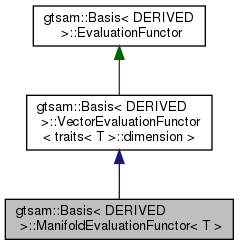
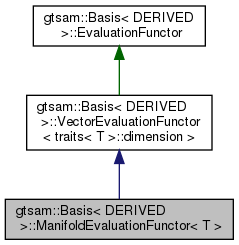
class gtsam::Basis< DERIVED >::ManifoldEvaluationFunctor< T >
Manifold EvaluationFunctor at a given x, applied to ParameterMatrix<M>. This functor is used to evaluate a parameterized function at a given scalar value x. When given a specific M*N parameters, returns an M-vector the M corresponding functions at x, possibly with Jacobians wrpt the parameters.
The difference with the VectorEvaluationFunctor is that after computing the M*1 vector xi=F(x;P), with x a scalar and P the M*N parameter vector, we also retract xi back to the T manifold. For example, if T==Rot3, then we first compute a 3-vector xi using x and P, and then map that 3-vector xi back to the Rot3 manifold, yielding a valid 3D rotation.