|
|
| L2WithDeadZone (double k=1.0, const ReweightScheme reweight=Block) |
| |
| double | weight (double distance) const override |
| |
| double | loss (double distance) const override |
| |
|
void | print (const std::string &s) const override |
| |
|
bool | equals (const Base &expected, double tol=1e-8) const override |
| |
|
double | modelParameter () const |
| |
|
ReweightScheme | reweightScheme () const |
| | Returns the reweight scheme, as explained in ReweightScheme.
|
| |
| Vector | weight (const Vector &error) const |
| |
|
double | sqrtWeight (double distance) const |
| |
| Vector | sqrtWeight (const Vector &error) const |
| |
| void | reweight (Vector &error) const |
| |
|
void | reweight (std::vector< Matrix > &A, Vector &error) const |
| |
|
void | reweight (Matrix &A, Vector &error) const |
| |
|
void | reweight (Matrix &A1, Matrix &A2, Vector &error) const |
| |
|
void | reweight (Matrix &A1, Matrix &A2, Matrix &A3, Vector &error) const |
| |
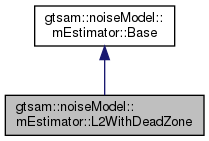
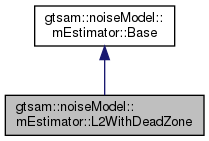
L2WithDeadZone implements a standard L2 penalty, but with a dead zone of width 2*k, centered at the origin. The resulting penalty within the dead zone is always zero, and grows quadratically outside the dead zone. In this sense, the L2WithDeadZone penalty is "robust to inliers", rather than being robust to outliers. This penalty can be used to create barrier functions in a general way.
This model has a scalar parameter "k".
- Loss (x) = 0 if |x|<k, 0.5(k-|x|)² otherwise
- Derivative (x) = 0 if |x|<k, (-k+x) if x>k, (k+x) if x<-k
- Weight w(x) = (x)/x = 0 if |x|<k, (-k+x)/x if x>k, (k+x)/x if x<-k
| double gtsam::noiseModel::mEstimator::L2WithDeadZone::loss |
( |
double |
distance | ) |
const |
|
overridevirtual |
This method is responsible for returning the total penalty for a given amount of error. For example, this method is responsible for implementing the quadratic function for an L2 penalty, the absolute value function for an L1 penalty, etc.
TODO(mikebosse): When the loss function has as input the norm of the error vector, then it prevents implementations of asymmeric loss functions. It would be better for this function to accept the vector and internally call the norm if necessary.
This returns (x) in mEstimator
Reimplemented from gtsam::noiseModel::mEstimator::Base.