#include <Expression.h>
Inheritance diagram for gtsam::BinarySumExpression< T >:
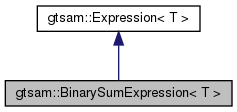
Collaboration diagram for gtsam::BinarySumExpression< T >:

Public Types | |
| typedef Expression< T > | type |
| Define type so we can apply it as a meta-function. | |
Public Member Functions | |
| BinarySumExpression (const Expression< T > &e1, const Expression< T > &e2) | |
| std::set< Key > | keys () const |
| Return keys that play in this expression. | |
| void | dims (std::map< Key, int > &map) const |
| Return dimensions for each argument, as a map. | |
| void | print (const std::string &s) const |
| Print. | |
| T | value (const Values &values, std::vector< Matrix > *H=nullptr) const |
| Return value and optional derivatives, reverse AD version Notes: this is not terribly efficient, and H should have correct size. The order of the Jacobians is same as keys in either keys() or dims() | |
| T | value (const Values &values, std::vector< Matrix > &H) const |
| virtual std::shared_ptr< Expression > | clone () const |
| const std::shared_ptr< internal::ExpressionNode< T > > & | root () const |
| Return root. | |
| size_t | traceSize () const |
| Return size needed for memory buffer in traceExecution. | |
| Expression< T > & | operator+= (const Expression< T > &e) |
| Add another expression to this expression. | |
Protected Types | |
| typedef std::pair< KeyVector, FastVector< int > > | KeysAndDims |
| Keys and dimensions in same order. | |
Protected Member Functions | |
| KeysAndDims | keysAndDims () const |
| T | valueAndDerivatives (const Values &values, const KeyVector &keys, const FastVector< int > &dims, std::vector< Matrix > &H) const |
| private version that takes keys and dimensions, returns derivatives | |
| T | traceExecution (const Values &values, internal::ExecutionTrace< T > &trace, char *traceStorage) const |
| trace execution, very unsafe | |
| T | valueAndJacobianMap (const Values &values, internal::JacobianMap &jacobians) const |
| brief Return value and derivatives, reverse AD version | |
Protected Attributes | |
| std::shared_ptr< internal::ExpressionNode< T > > | root_ |
Detailed Description
template<typename T>
class gtsam::BinarySumExpression< T >
A BinarySumExpression is a specialization of Expression that adds two expressions together It optimizes the Jacobian calculation for this specific case
Member Function Documentation
◆ clone()
template<typename T>
|
inlinevirtualinherited |
- Returns
- a "deep" copy of this Expression "deep" is in quotes because the ExpressionNode hierarchy is not cloned. The intent is for derived classes to be copied using only a Base pointer.
◆ value()
template<typename T>
|
inlineinherited |
An overload of the value function to accept reference to vector of matrices instead of a pointer to vector of matrices.
The documentation for this class was generated from the following files:
- /home/docs/checkouts/readthedocs.org/user_builds/gtsam-jlblanco-docs/checkouts/latest/gtsam/nonlinear/Expression.h
- /home/docs/checkouts/readthedocs.org/user_builds/gtsam-jlblanco-docs/checkouts/latest/gtsam/nonlinear/Expression-inl.h